


Flames born from human hands
Flames that engulf all
Flames that sink into the depths of the ocean
In this world, the opposing elements, water and fire, hold different powers.
Fire—brings light and warmth, broadening the possibilities of life,
yet also burns whole lands, possessing the power to decimate life itself.
Water—the source of life, a precious resource in danger of reaching its limits,
also brings uncontrollable disasters, growing ever more intense in the modern age.
While both are essential to human survival, each is a source of great fear.
The Canary Islands are located off the African continent, facing the vast Atlantic Ocean. This uninterrupted expanse of sea, ironically, gives rise to some of the world's most tumultuous waves. Millions of years of volcanic eruptions beneath the ocean gave birth to the rocky terrain of these islands. The coastline is an unbroken stretch of arid lava rock.
As I gazed at the waves below from the cliffs of black lava rock, each crashing swell sent shockwaves resonating through my body. The waters are so deep that even the strong sunlight striking the ocean's surface is swallowed by the darkness below. At night, I returned to the same place. This time, the waves shimmered in the moonlight—enormous black masses repeatedly crashing against the cliffs before vanishing again, like vicious black flames in motion.
Fire and water are fundamentally opposed. Yet, just as they seem to transform beneath the light of the sun and the moon, I came to see them as two inseparable, complementary forces within a single whole. This idea of “duality” became the foundation of the collection title, Sea of Fire, INFERNO.
To express these paired yet opposing forces, I drew inspiration from monogi, a traditional costumechanging technique in Noh and Kyogen theatre, in which performers change garments in full view of the audience. Monogi is often used to depict a character's transformation into a demon or to signify the passage of time within a performance.
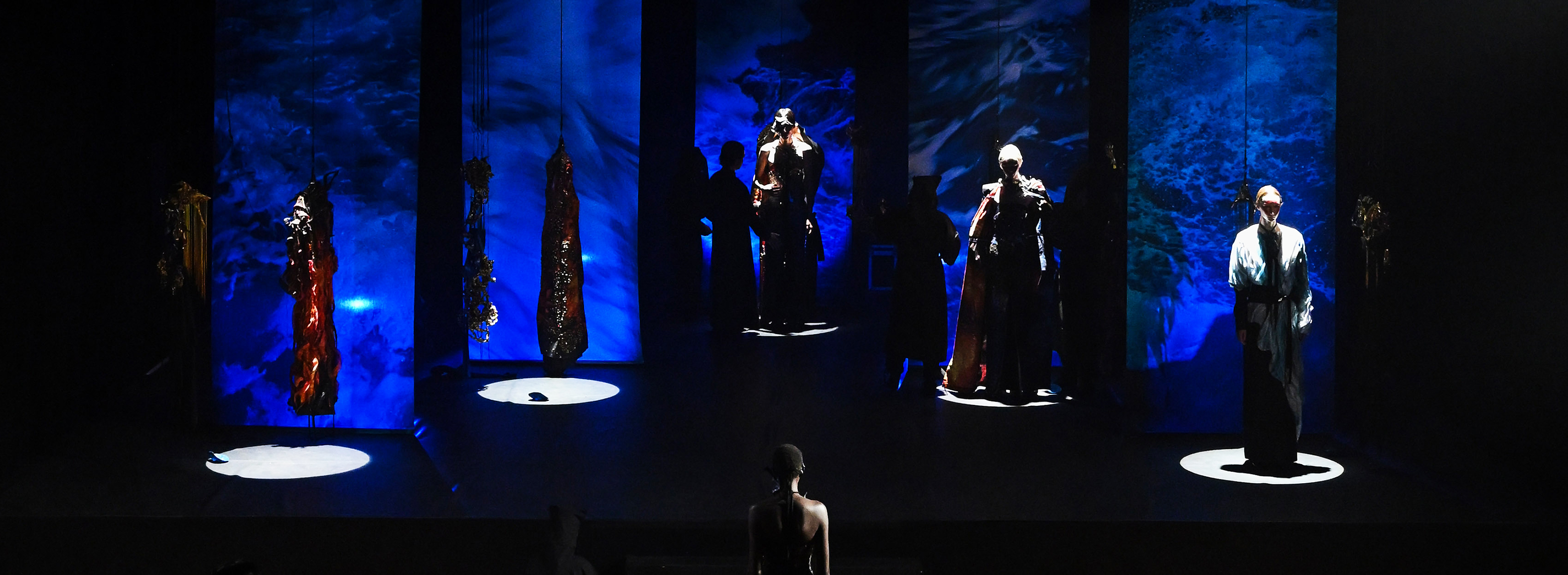
Likewise, the Japanese kimono is constructed entirely from rectangles, yet it can assume countless forms depending on how it is worn. Its patterns also carry meaning, stories, and prayers. Inspired by the nature of the kimono, five performers wear garments of the same construction. As each piece changes from blue to red, it takes on an entirely different presence.
Our signature ceramic dress, “Fragile Armor,” which we have presented over the past couple of years, also embodies this sense of duality. Traditionally, armor exists to protect the human body while symbolizing conflict. By creating armor from fragile ceramic, I seek to redefine what armor can represent.
Like “Fragile Armor,” the transition from blue to red, from surface to underlying meaning, reveals the essence of duality.
–Yuima Nakazato
炎は人が持ち込み
炎は全てを飲み込み
炎は深い海に沈む
この世界で、水と火は対になり、異なる力を持つものとして存在する。
火は、灯りや暖をとることを可能にし生存領域を広げる。
一方で、地上を焼き尽くし、生命を飲み込む力も持つ。
水は命の源であり、枯渇が危ぶまれる尊い資源である。
一方で、時に猛威を振るい災害をもたらし、今日のそれはより一層脅威である。
どちらも人間が生きる上で欠かすことはできず、どちらも恐れの対象である。
カナリア諸島は、アフリカ大陸沖で、先に遮るもののない広大な大西洋に面している。 そのため、世界で最も激しい波が起きる場所として有名である。 数百万年に渡り繰り返し海底火山が噴火したことにより、隆起の激しい島々が誕生した。 海岸には溶岩でできた荒々しい岩場が続く。
私は、黒い溶岩の崖に波が激しくぶつかるたび、振動が全身に伝わるのを感じながら眼下の波を眺めてい た。 太陽の光に照らされても、透き通る海水が黒く見えるほど深い。 夜、私は再び同じ岩場を訪れてみた。波は月明かりに照らされ、黒い巨大な塊が光り輝きながら崖にぶつ かっては消えていく。その姿はまるで激しく燃え盛る黒い炎の塊のようであった。
火と水は似て非なるものであり、そして太陽と月という異なる光に照らされそのものが変異するように感 じ、表裏一体(Duality)の意味を持つ存在として「火の海」(INFERNO)という言葉が浮かんだ。
私は、これらの対となる2つの存在を、能や狂言などにある、舞台上で、装束を着替えさせる伝統的な演出 「物着」で表現しようと試みた。「物着」とは、登場人物が鬼に変異したり、劇中で時の経過などを表す ために用いられる。 また、着物は全て長方形から成り、着こなしにより様々な姿に変化し、そして柄で意味や物語、祈りを示 す。この着物の在り方に着想を得て、舞台上に立つ5人は全て同じ形の衣服を纏っているが、その1着の服 は青から赤に変化し、全く異なる装いとなっている。 ここ何年も作り続けている陶器のドレスは、「繊細な鎧」と呼んでいる。鎧は、人を守ると同時に、戦う ための存在である。割れてしまう陶器で鎧をつくることは、鎧の意味を変化させる。
青から赤に変化する様、繊細な鎧に、意味の表裏、デュアリティを込めた。
–中里唯馬
